What to Do After a Car Accident, Step by Step
What to do after a car accident: stay safe, check for injuries, call for help, swap details, record evidence and report to police and your insurer in time.
After a car accident, make the scene safe, check for injuries and call emergency services if needed. Then exchange details, record evidence and report the accident to the police and your insurer as your local rules require. Staying calm and following these steps in order protects your health, your safety and any future claim.
1. Stop and make the scene safe
Always stop after an accident, however minor. Leaving the scene can be a serious offence in many countries.
Turn on your hazard lights and switch off the engine. If the cars can be moved and no one is hurt, move them out of traffic if local rules allow. If not, stay in a safe place away from moving vehicles.
Use a warning triangle or other safety equipment if you carry it and local law requires it. Wear a reflective vest if you have one, especially at night or on fast roads.
2. Check for injuries and call for help
Check yourself and your passengers first, then others involved. Call your local emergency number straight away if anyone is hurt, trapped or unconscious, or if there is fire, leaking fuel or a serious hazard.
Do not move an injured person unless they are in immediate danger, such as from fire. Moving someone with a neck or back injury can make it worse. Follow the emergency operator's instructions until help arrives.
3. Exchange information
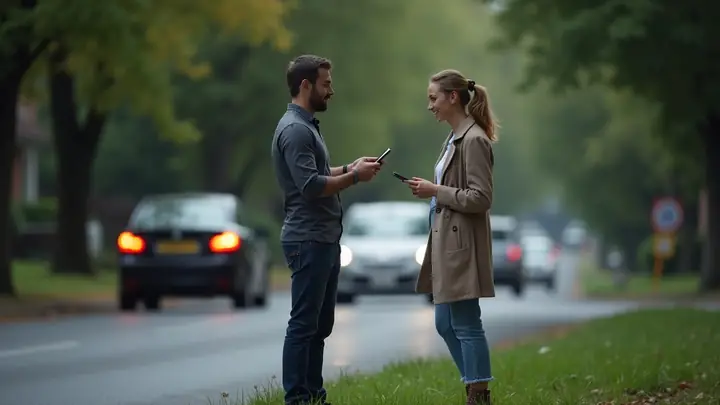
Once everyone is safe, exchange details with the other people involved. Stay polite and stick to facts.
| What to collect | Why it matters |
|---|---|
| Full names and phone numbers | To contact drivers and owners later |
| Driving licence details | Confirms who was driving |
| Insurance company and policy number | Needed to start a claim |
| Vehicle registration or plate numbers | Identifies each vehicle |
| Make, model and colour of each car | Helps match records |
| Names and contacts of witnesses | Independent accounts support your claim |
| Police officer's name and report number | Needed if police attend |
If the other driver refuses to share details or leaves, note their plate number and a description, and tell the police.
4. Record evidence at the scene
Evidence is easiest to gather right after the accident. Use your phone to capture as much as you safely can:
- Photos of all vehicles from several angles, including close-ups of damage.
- The wider scene: road layout, traffic signs, signals and road markings.
- Skid marks, debris and the final positions of the cars.
- Weather, lighting and road surface conditions.
- The time, date and exact location.
Write a short note of what happened while it is fresh in your mind. Include the direction each car was travelling, speeds if you know them, and what you saw just before the impact.
5. Be careful what you say and sign
It is natural to apologise, but avoid saying the accident was your fault. You may not know all the facts, and your words could be used later to decide responsibility.
Do not sign any document at the scene unless you understand it fully and it is an official form required by local law. Be cautious about agreeing to a cash settlement on the spot, as damage and injuries can turn out to be worse than they first appear.
6. Report the accident
Reporting rules vary widely. Some countries require a police report for every collision, while others only require one when someone is injured, a road is blocked or damage passes a certain level. Some use a joint accident form that both drivers complete and sign.
Contact your insurer as soon as you reasonably can, even if you do not plan to claim. Most policies set a deadline for reporting, and missing it can affect your cover. Give honest, factual answers and keep a record of every call and reference number.
If you are unsure what applies where you are, check with the local police or your country's road safety or transport authority.
7. Follow up after the accident
See a doctor even if you feel fine. Some injuries show symptoms only later, and a prompt medical record helps if you need to claim.
Keep copies of everything: photos, notes, repair estimates, medical bills, receipts and letters from insurers. Ask your insurer how repairs work under your policy before booking any work.
If there is a dispute over fault, significant injury or a large claim, consider getting advice from a qualified local lawyer or a consumer advice service.
The bottom line
After an accident, put safety first, get help for anyone injured and then gather details and evidence calmly. Avoid admitting fault and do not sign anything you do not understand.
Report the accident to the police and your insurer as local rules require, and keep thorough records. Knowing these steps before anything happens makes it much easier to act clearly if it does.
Frequently asked questions
Do I always need to call the police after an accident?
It depends on where you are. Many places require a police report if someone is injured, if the road is blocked, or if damage is above a certain level, and some require it for any collision. Check your local rules, and call if you are unsure.
Should I admit fault at the scene?
It is generally wise not to. You may not know all the facts, and a casual apology could be treated as an admission. Stick to facts and let the police and insurers decide responsibility.
What if the other driver has no insurance or drives away?
Write down whatever you can, such as the plate number, vehicle description and direction of travel, and report it to the police promptly. Contact your insurer too, as some policies or local schemes cover uninsured or unidentified drivers.
Should I see a doctor if I feel fine?
Yes, it is sensible. Some injuries, such as whiplash or concussion, may not show symptoms for hours or days. A medical record made soon after the accident can also support an insurance claim.
Disclaimer: This guide is general information only and may not fit your situation or country. Rules, prices and requirements change, so check the details with the official source or a qualified professional before you act. Read our full disclaimer.